
New EU Law on Pet Protection: What It Means for Pet Owners and Professionals
By Johanna
Published April 29, 2026
Introduction
The European Union has approved its first comprehensive legislation aimed at protecting cats and dogs across all member states. This marks a significant shift from fragmented national rules toward a unified framework.
Given the scale of pet ownership and the growth of online pet sales, this regulation addresses long-standing gaps in traceability, welfare standards, and cross-border enforcement.
What the new EU law introduces
1. Mandatory identification and registration
All cats and dogs will need to be microchipped and registered in interoperable databases across the EU.
This creates traceability:
- clearer ownership records
- easier tracking of cross-border movement
- reduced abandonment and illegal trade
2. Regulation of breeding practices
The law introduces restrictions on harmful breeding practices, including:
- inbreeding
- breeding animals with traits that compromise their health
The objective is to reduce systemic health issues linked to profit-driven breeding.
3. Stricter standards for breeders and sellers
Breeders and sellers will be required to meet minimum welfare standards, including:
- proper living conditions
- veterinary oversight
- increased transparency
This also improves consumer protection by reducing fraud and the sale of unhealthy animals.
4. Measures against illegal pet trade
The regulation extends to imports and cross-border movement, closing loopholes often used in illegal trafficking.
This is particularly relevant in a market where a large share of pets are acquired online.
Implementation timeline
The regulation will be phased in over several years:
- Breeders and sellers: ~4 years
- Dog owners: up to 10 years
- Cat owners: up to 15 years
This gradual rollout reflects the complexity of aligning systems across all EU countries.
What this means in practice
A stronger regulatory baseline
For the first time, there is a shared EU-wide standard for pet welfare.
Improved traceability
Microchipping and registration create accountability across borders.
More transparency—but not complete clarity
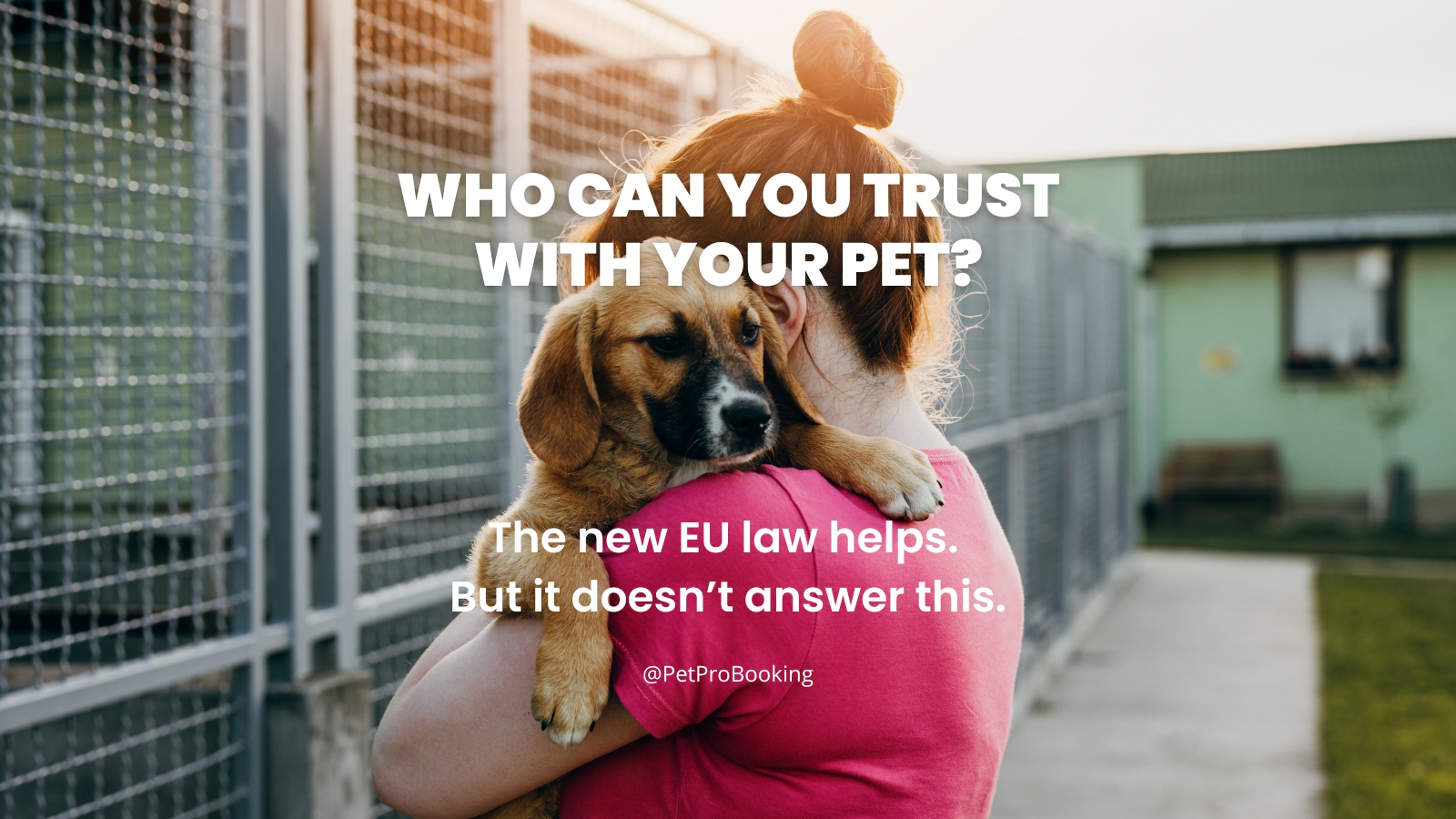
While regulation improves conditions, it does not fully solve how pet owners identify trustworthy professionals locally.
The remaining gap: trust, visibility, and time
The new EU regulation improves welfare standards—but it does not address the day-to-day friction experienced by both pet owners and pet professionals.
For pet owners
Finding the right pet professional remains time-consuming and uncertain.
- Trust is difficult to establish
It’s hard to know who is reliable. Reviews on platforms like Google or Facebook are often inconsistent or lack context, forcing owners to “test” multiple professionals before finding the right fit.
- A long and fragmented booking journey
On average, it takes ~32 hours to find and book a pet professional (based on your Luxembourg survey). The process includes searching across multiple channels, comparing options, reaching out, waiting for replies, and coordinating availability.
- Lack of convenience and standardization
Each professional uses a different booking method (phone, email, WhatsApp, platforms, etc.). Pet owners typically use 5+ services per pet, multiplying the complexity.
For pet professionals
At the same time, professionals face operational and trust-related constraints.
- Trust is hard to build and showcase
A lack of standardized, credible profiles makes it difficult to prove quality and stand out—especially when reviews are scattered or unreliable.
- Significant time spent on administration
Many professionals spend 1–3 hours daily on client communication (calls, emails, follow-ups), reducing time available for actual service delivery.
- Constant interruptions and fragmented workflows
Managing bookings and client needs across multiple channels leads to frequent disruptions and inefficiencies throughout the day.
A growing structural problem
With more pet services emerging, the ecosystem is becoming increasingly fragmented and overwhelming—for both sides.
Regulation sets a foundation, but it does not simplify how people find, trust, and interact with each other.
Bridging the gap
This is where Pet Pro Booking fits in.
It addresses the same three core issues:
- Trust → verified professionals are highlighted, booking-based reviews, and transparent profiles that help take informed decisions.
- Time → faster discovery, streamlined booking, better pre-appointment information, and reminders
- Convenience → one centralized platform for all pet services instead of multiple channels, pet's history and follow up all managed in one place
By structuring, centralizing and verifying professionals & reviews, Pet Pro Booking complements regulation with practical, user-facing trust.
Conclusion
The new EU law is a foundational step toward improving animal welfare and reducing abuse.
However, regulation alone does not solve the full problem. The combination of regulation + transparency + accessible information is what ultimately improves outcomes for both pets and owners.
Find trusted professionals
Are you looking for a verified professional for your pet?
👉 Find the perfect match on Pet Pro Booking (look for the green "verified" badge or use the filter)